Tuesday, August 25, 2020

The Lure of the Sea


My daughter-in-law Heather sent me this cool photo recently of a tug and barge coming through Hull Gut south of Boston Harbor. In the foreground is a lobster boat heading out to check traps. The photo has all kinds of pleasant associations for me. First of all, our middle son Joe is steering the tug and barge loaded with 80,000 barrels (3.3 million gallons) of ethanol through Hull Gut, the narrow straight at the end of the town of Hull where Heather and our oldest son Matt live.

Matt also works on a similar vessel as does our youngest son Ned. This makes it convenient when people ask what our boys are doing. "Still on the tugs," I can reply. The tugs and barges belong to Reinauer Transportation Company, based on Staten Island, New York. The company avoids having relatives working together so the boys are on separate tugs.

The boys (they're not really boys anymore) drive down to New York every two weeks from their homes south of Boston. Once at work, the barge takes on petroleum products, usually at a refinery in northern New Jersey. Then they head for tank farms up and down the east coast between Maine and Florida, with occasional runs to Louisiana or Texas. After two weeks, they drive home for two weeks off. So effectively, they have twenty-six weeks of (unpaid) vacation. It's great if you don't mind being on the boat for two weeks.

The photo above is a bit deceptive, because the 42 foot lobster boat in the foreground, which belongs to Heather's brother Chad, makes the 424 foot tug and barge look smaller than they are. The tug, the Kristy Ann, is locked to the stern of the barge by a pair of hydraulic rams. The barge is less prettily named RTC 80. Unless the tug or barge needs repairs, the two units will remain together.

Joe is first mate on the Kristy Ann. He works six hour shifts throughout the two week "hitch," alternating with the captain. There is a second mate and one deckhand. There is also an engineer and two bargemen.

Joe's barge had loaded product two days previous at the refinery in New Jersey, and travelled northeast along the coast and then through the Cape Cod Canal, traveling at 10 nautical miles per hour. As it approached Hull Gut very early in the morning, an assist tug based in Boston came alongside. The gut is narrow and the current strong and it's good to have help in such a place. After unloading part of her cargo at the tank farm in Braintree, Kristy Ann headed north to Portland, Maine before returning to New York.

How did our three sons end up as merchant mariners? Good question.  It was a matter of interests skipping a generation. My father was a sea-going man.  He joined the Merchant Marine at age 17, got himself torpedoed in the Pacific in WWII, then settled into a career as pilot of the Boston Fire Department's fireboat. When the kids were growing up, we made an annual 1,700 mile trek from Minnesota out to Hull where my parents and siblings lived. The boys developed their nautical genes on grandpa's sailboat.

Two of my brothers worked for Reinauer and when our boys finished school and were looking for work, one of my brothers suggested the tugs. Matt has been working on the tugs the longest. He's in charge of the barge when he goes to work, making sure the right fuel gets into the right compartment and also insuring the barge is balanced. Joe passed a series of difficult Coast guard examinations, and after extensive on-the-job experience, he became a first mate. He'll eventually become a captain, the good Lord willing. Ned is a deckhand. The deckhand cooks the noon meal, keeps the tug clean, and, in the course of the year. chips and repaints the entire tug.

The tug-barge combination is longer than a football field and Joe says he appreciates having his deckhand up on the bow with a walkie-talkie during landing operations.

Carry on gentlemen and we shall see you ashore.

Kristy Ann passing through Hull Gut with assist tug.


A Killing in Kittson County


These last couple of weeks before the summer solstice contain the purest light of the year and the highest hopes. The days are still getting longer, but that quits as it must on the solstice. These days remind me of the time many years ago when I plowed land up in Kittson County near the Canadian border.

I worked for a farmer who was based near Badger. He had bought lots of land about an hour's drive to the northwest in Kittson County which is in the very northwest corner of Minnesota. To the north is the province of Manitoba and North Dakota is to the west, across the Red River.

It was gravel roads all the way up to these new lands. I drove my own vehicle, a 1970 AMC Rebel wagon. My employer provided my gas and paid for my driving time. The fields had been carved out of the woods, and were relatively small and irregularly shaped compared to the fields back in Roseau County. Not many people lived in this area anymore. I could go all day without seeing another human, though every other day someone from the Badger farm would haul up fuel for my tractor.

The tractor was a Ford four wheel drive monster. It had a commodious cab with air-conditioning and a radio on which I listened to the Canadian Broadcasting Corporation and got an education in Canadian politics and culture.

I was supposed to grease the tractor and plow before I started work for the day, but the mornings were cool and the equipment was covered with dew, so I waited till later in the morning to grease everything. Working by yourself, you can bend the rules a bit. The mornings were beautiful, like the mornings we're having now. When I arrived at the tractor, the cobwebs in the woods sparkled with dew. Sometimes a deer would observe my funny looking green wagon before waving its white tail goodbye.

One of the farms was different in that someone still lived there. Mrs. Barder's husband had died recently and she had decided to sell the farm, but didn't want to leave the place she had lived for the past fifty years, even though the nearest town was twenty miles away. So my employer gave her a life estate on the house.

When I worked at the Barder farm I'd have a chat with Milly before I started work. One morning she asked if I'd do her a favor.
"Sure," I said.
"See that wire?" she said.
I could see a wire attached to a stake in the front yard leading into the tall grass that surrounded her house.
"That wire's attached to a trap and there's a skunk in the trap."
I followed her around the house and saw a skunk struggling in a leg-hold trap. Actually I just saw the tall grass waving back and forth. I took Milly's word there was a skunk in there.
"Can you shoot him?" she asked.
I am not a hunter. I have shot guns to see what it was like, then I put them aside. I trap nuisance squirrels at home in a live trap then let them go five miles from home.
"But you can't shoot him here. He'll stink up the house."
Milly had a plan. We would attach one end of the wire to my bumper and she would drive my wagon past me and I would shoot the skunk.
"Here you go," she said. She handed me a single barrel shotgun that looked like it had been used at the Alamo. The barrel was wrapped with wire to hold it to the stock.
"You know how to use this?' she asked sensing my reluctance.
What little machismo I have came to my rescue. "Of course," I said.
I figured out how to break open the barrel and inserted the shell she handed me. I untied the wire from the stake and attached to my rear bumper. I was in a dream-like over-my-head sort of state as Milly hopped into my car. I stood a good ways from the house and she drove by me at a high rate of speed with the skunk spinning in the trap behind. You don't have to be an expert shot to hit anything with a shotgun.
We dragged him into the field and Milly retrieved her trap. Later I plowed a furrow beside the skunk and pushed him (with a long stick) into it. I felt sorry for the skunk, but felt glad I was able to help out an old woman. Milly's long gone now and I expect the skunk has visited her in that place where the sun always shines.


Nature's Web

Shed Care


It's amazing how many jobs a person can put off if he sets his mind to it. With the stay at home order and this nice weather, I've been forced to face reality. Take our old chicken shed for example. Once it was a fine little building, suitable for keeping chickens or storing stuff too valuable to throw away. But the sky is now coming through the roof and the sides and it has slipped off it's cinder block foundation. I've put a tarp over the valuables inside the shed, the last resort of the procrastinator.

When the shed went onto the ground, a family of woodchucks burrowed underneath. Woodchucks are hard on gardens. Teresa suggested we get the shed back on the blocks to make it less cozy for the woodchucks. I suggested we build a fence around the garden since that would also keep out the deer. So we built a beautiful six-foot tall fence around the garden. But the woodchuck dug underneath the fence. So we put chicken wire along the bottom of the fence and ran it out six inches on the ground and staked it down. The woodchuck moved over to the flowers around the house.

"Let's get the chicken house back in its blocks," Teresa suggested. But I had a job to go to and pizza to make and books to read. And people came to visit so there was no time left over for chicken sheds. Then I retired, but there were still non-chicken shed related distractions. When Teresa retired things got more serious and it took all my powers of procrastination to keep the shed on the ground.

But not even I could fight the virus. The needs of the shed buzzed around in my brain like an angry chicken. I had put Teresa off the previous year by borrowing one of our friend Steve's handyman jacks. I put the jack in another shed and winter came and so passed another year.

When the leaves of the oak trees got as big as a squirrel's ear, Teresa suggested we get the chicken shed back on its blocks. She had seen a woodchuck lurking on the north side of the house. "I should really have Steve's other jack so I don't twist the shed as I jack it up," I said.
"Well go ahead and borrow it," she said.
"I hate to deprive him of his jack. He uses it all the time."
Yeah, I was getting pretty desperate.
"Let's just try jacking it up with the one jack,"  I said, hoping it would start to rain.

As I started jacking on one end of the shed, I could hear a faint splintering of wood. "Go get Steve's jack," Teresa suggested. I called Steve and promised I would return his jack before the sun went down that day. We now had two handyman jacks, but because the shed was on the ground, we had to dig a hole to get the base of the jack under the beams that supported the floor. With a jack at each end of the building, we were able to raise that end several inches and put blocks under the beams. Then we moved the jacks to the other end and did the same thing.
Next job, new roof and siding. Now!

With the shed up in the air. my procrastination flew the coop. I was fully engaged and now the fun began. We had to dig out the cinder blocks, which had sunk into the earth. Since the shed had migrated to the west, the four blocks on the east were exposed and easy to get at. The blocks on the west side however were under the shed and I wished Steve had a small earth excavator I could borrow.

I noticed Teresa struggling with a root under the southeast corner. She's like a terrier when it comes to roots. At last she yanked it out. Then she screamed, because she hates all rodents alive or dead. She had unearthed a petrified woodchuck! Wow! It was gross. But was it really? I hosed it down. No, it was just a root that looked exactly like a petrified woodchuck. I put it in our outdoor museum.

The most time consuming part of the job was getting the blocks in place and at equal elevations so the shed would be level when the jacks were removed. This took a lot of pulling the cinder blocks out, removing more dirt or putting some back in. We also discovered two blocks under the center beam. They had to be just right too. We eyeballed the shed and also used a bubble level until it was good enough.
Playing in the dirt

The afternoon was well advanced when we took a lunch break. It took another hour to clean up all the dirt we had dug out and to put the tools away. There was enough dirt left over to fill the new tomato boxes I had built at Teresa's suggestion. My last task was to return Steve's jacks. Without those fine jack's, the chicken shed would still be on the ground. We beat gravity for another day.

As good as it gets

Rite of Spring


I know spring has begun when my colleague WannaskaWriter, who hereafter will be referred to as Steve, contacts me that he's stuck. I drop everything and run over to his place to help. I'm a bit of an expert at getting vehicles unstuck using little more than a jack, some chunks of wood, and an old tire or two.

I learned my skills while working for an impetuous German industrialist who had bought up thousands of acres around Badger and up in Kittson County. He bought the land as a hedge against a possible Soviet invasion. Herr G. would look out his window in Berlin and if it wasn't raining, he'd order all his tractors out into the field.

Of course we got stuck right away because Badger and Kittson County are soggy places compared to Berlin. I drove a big four-wheel-drive tractor with a huge implement behind. When stuck out in the boondocks, I was on my own. I had to get my handyman jack under the tongue of the implement to relieve pressure on the hitch pin so I could drive the tractor ahead. It was almost impossible to get an unencumbered tractor stuck. I drove ahead thirty feet and connected a steel cable to the implement and yanked it out of the soggy spot.

Things are a bit different with Steve, since it's often his tractor itself that's stuck. Steve has a fine Massey-Furguson 180 Diesel tractor, but it only has two-wheel-drive. Steve has often said he wished it had four-wheel-drive, but it doesn't. By the time I arrive, Steve has already assembled all the equipment needed to get out of his pickle. I'm not pretending I'm essential to rescue Steve. He will get it done one way or another. But Steve knows that I'm familiar with which of the saints solves which problem, so when I arrive he says, "Let us pray."
"Saint Frances of Rome, get us out of here."


I remember one situation when his 4WD truck was stuck. I counseled using his tractor to pull out his truck. He was leery of that knowing how soft the spring fields were and sure enough, the tractor was soon sunk right in front of the truck. Steve didn't call me for a couple of springs after that.

Well this year it was my turn. Last Saturday I drove over to Wayne's World to pump out the well. We call the forty acres across the road Wayne's World because our friend Wayne used to own it. Also in memory of the old SNL skit. Wayne had planned to move a trailer house in there and had a road built and a well dug. Then he bought another place with a house already on it. He asked us if we wanted to buy the piece. We burned wood at the time and this piece of land had lots of easily accessible popple (aspen).

A few years after we bought the land, the State sent us a letter saying all unused wells had to be either filled in or pumped at least once a year. It seems children were falling into unused wells. Our well only had a five inch diameter pipe sticking out of the ground, so not even a resourceful child could fall down it. Not wanting to fill in a good well, I bought a small cast iron hand pump and stuck on eight feet of plastic pipe.

Once a year I'd haul the pump over to the well and pump out a few gallons. I had to remember to bring a hammer to knock off the plastic cap and a jug of water to prime the pump. After a while I noticed the water was always at the top of the well pipe when I removed the cap. Also, a rust stain began to form on the outside of the white pipe. We had a flowing well.

So there was no need to pump it out, but every few years I'd drive over and pump out some water just for the heck of it, as I did on Saturday. The first half of the road is in the open, while the second half is in the woods. I really should have stopped halfway in and scouted ahead on foot. I usually turn around where the trailer would have been, but I could tell conditions were boggy. "I'll just back out," I thought.

After pumping the well, I hopped in the truck and started backing. I could see in the mirror there was a spot where my tires had cut through the leaf litter. It was here I met my waterloo. Once stopped, I resisted rocking the truck back and forth. It just gets you dug in deeper. I could have walked the half mile home and returned with planks and my (Steve's spare) handyman jack and gotten myself out in a couple of hours. But we had a ZOOM meeting with friends coming up, so I emailed Steve requesting a Sunday pull-out.

Steve emailed right back and said Sunday was his day for helping friends in need. He included a list of all the equipment he'd be bringing, forgetting only a mini-Thai elephant. My rescue was anticlimactic. Steve hitched his thirty foot chain between my rear bumper and his and quickly popped me out of my hole. But instead of stopping, he accelerated till we reached the open part of the road. I had an exciting time keeping my truck from slewing into the trees along the road. No harm done. And now it was time for Steve's celebratory Guinness.

Salvation Army Tank


Tuesday, April 14, 2020

La Dolce Vita, Irish Style


On Easter Sunday, the Italian opera singer Andrea Bocelli sang several religious blockbusters in front of the deserted Duomo Cathedral in Milan. This is the best we do until the Covid-19 Virus passes over. Many people won't return to normal till there's a vaccine.

The Bocelli video reminded me of one of my favorite travel memories. We had gone to Ireland with three other couples and were staying in the fine little town of Dingle in County Kerry on the west coast. Late one evening as the pubs were closing, we were walking back to our lodgings. Our friend Mitch had just discovered a whiskey called Mitchell's.

He felt the whiskey was named after him. We all sampled it at the pub and Mitch bought the remainder of the bottle which he now cradled under his arm. (This story is not about Mitch breaking the bottle, so don't worry about that.) It was uphill all the way from the pub to our lodgings and as we reached the big church, Mitch decided to take a break on the church steps. He stretched out on the broad steps and, propping himself on his elbow, started to sing.

Mitch is a fine singer and the acoustics were great. His first songs were from the classics, but in the second half of his program, he switched to show tunes. I particularly remeber "O, What a Beautiful Morning." Not that Mitch needed it, I started directing him. I had no podium so I was able to move around the steps, quite exuberantly. It was a night to get carried away.

People leaving the pubs stopped to listen. Second floor windows went up. There was general applause when Mitch returned to his feet. The next day I was in the pub across from the church. It's called Dick Mack's. The pub, not the church. "One of the denizens there said. "We saw you by the church last night."
   "Oh-oh." I was about to crawl into the snug.
   "No, it was great," he said, and he bought me a pint. To be sure, there's no greater compliment in Ireland.

Listen to the music.

Saturday, March 21, 2020

Stay Home !


The Covid-19 virus put the kibosh on our latest trip to Massachusetts. Our niece, Sarah McDonnell was to marry Sean Thorpe in Providence, RI on March 28. We were going to take our usual five day back roads jaunt out east, savoring the back country that only the locals usually see.

Then the new virus hit. Sarah's wedding was postponed to July and then to September. What a shame for Sarah and all involved. A McDonnell wedding is something to see. I've been to several and they don't disappoint.  Initially Teresa and I planned to drive out anyway to see the family, but as the superstructure of the normal started to collapse, we decided to stay home.

I was philosophical about it. Lots of other people had it a lot tougher than me. But couldn't I slip one more little trip in before the virus exploded? Stay home we were told. Especially old timers like myself. My old friend Steve Reynolds and I had our bottle run scheduled for yesterday. Once a month we take our glass bottles and jars to Thief River Falls because our local recycling bins don't take glass.

We went back and forth whether we should leave home and travel the 60 miles to Thief River, then finally decided to go ahead with it. Since this might be the last trip anywhere for a long time, we decided to dump our bottles in Thief River then head west to North Dakota. We usually breakfasted in Thief River, but all the restaurants are closed, so I had breakfast at home and packed a lunch for Steve and myself. Steve cooked coffee.

Steve picked me up at nine a.m. in his 1998 Subaru Legacy Outback. We took the back roads down to Thief River. March 19 was listed as the first day of Spring, but the fine print said Spring would not start till 10:50 p.m.  There had been an inch of snow last night so we were able to see that other than the deer, we were the first travelers over some of these roads.  We dropped our bottles in the bins at Hugo's Supermarket. We usually went into Hugo's for something, but not today.

It was a bright and windy day

To get into North Dakota, you must cross the Red River and there are not a lot of places to do this. We used the bridge at Oslo 45 miles west of Thief River. Steve's ultimate goal for this trip was Edinburg, where he had helped build a sod house with some friends in 2006 as part of Edinburg's 125th Anniversary. Let me say something here about North Dakota. It's the least visited by tourists of all the fifty states. It ranks forty-fifth in the number of confirmed Covid-19 cases. If we were going to go anywhere and not spread or pick up the virus, North Dakota would be ideal.

Something else about North Dakota. It's filled with lots of little towns which only the residents have ever heard of. If you go to the western part of the state you'll find true ghost towns. In the east half, these towns of 90 to a couple of hundred manage to hang on thanks to the people that live in them. If there's any life in them at all, there will be a bar serving cheap beer, pickled eggs and pizza. There may even be a second bar disguised as a Veteran's Club. There may also be a Senior Center and a miscellany of other businesses. Scrapbooking is big.

That inch of snow that fell last night was by noon whipping across the blacktop roads, reducing visibility a notch. It was 15 above but the sun warmed the road enough to cause the blowing snow to stick to  the road then freeze to an icy coat. Steve's vehicle zipped along with no slips or slides.

Forest River, pop. 119, proved an interesting detour. A hundred and nineteen people doesn't seem like a lot, but how many close, personal friends do you have? Tom's Bar was open for business. Minnesota had closed all bars and restaurants except for takeout earlier this week but North Dakota is famous for not telling it's citizens what to do. The governor had advised bars and restaurants to close, which was good advice for metropolises like Bismarck and Fargo, but Forest River was probably safe for now. (All ND bars and restaurants did close by governor's order the next day.)

World's shortest curling rink, Forest River

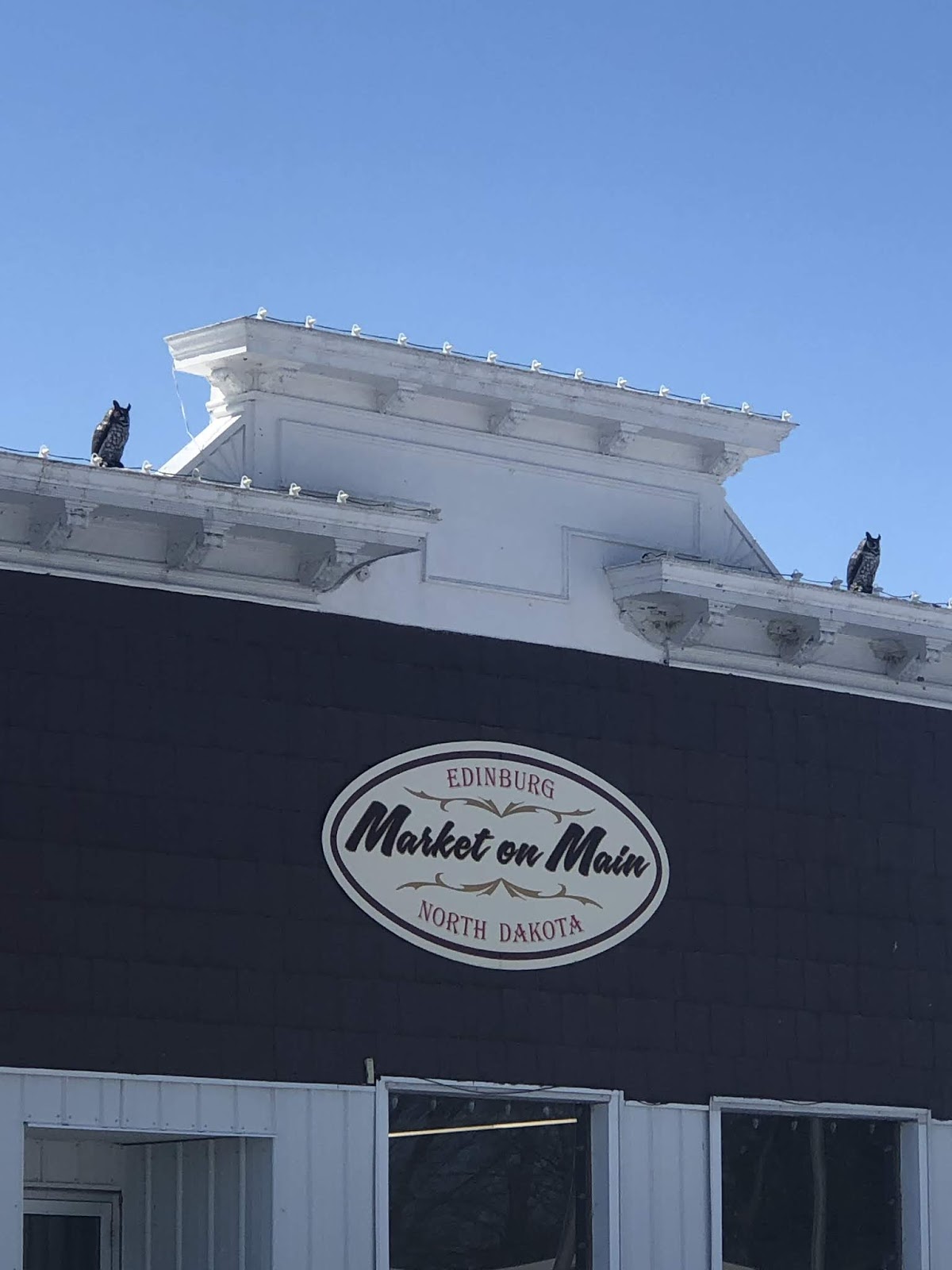
In normal times, Steve and I might have dropped into Tom's to gauge the tenor of the place, but we did not want to bring our hot Minnesota microbes into contact with the unsuspecting denizens of Tom's.  We pushed on north to Edinburg, pop. 184.  Some of these towns are in genteel decline, but Edinburg had some go to it. People coming and going at the Market on Main. Walkers out walking, all muffled except for their eyes. We parked on Main Street and pulled out our sammies and coffee and enjoyed a fine meal.

The Owls of Edinburg

After lunch Steve showed me where he had built the Quasquicentennial sod hut back in 2006. Not a trace remains. These huts were only meant to last till the pioneers could build more permanent structures. Steve wanted to explore some of the back country around Edinburg and look for the farms of the old folks he knew of. We took some narrow, snow choked roads along the river bottoms. The narrow river bottom was full of moisture-loving trees, cottonwoods, boxelders, many  leaning crisscrossed over the frozen stream. This thick vegetation was in contrast to the open plains above the riverbed.

We could have headed home from there, but decided to go west a bit to Milton. We had checked out this town on previous trips to the Dakotas and had been amused by a hokey shrine to John Wayne in the display window of the defunct grocery store. When we arrived in Milton we were shocked to find that the grocery store had been torn down.

I found a nine year old video on YouTube posted by some young Brazilians who had been living in Milton. In the video, loud samba music plays from laptop speakers outside the back door of their house. There's banter in Portuguese and some English for the benefit of a couple of American friends. One of the Brazilians squirts lighter fluid into the charcoal grill every few seconds. "This is how we barbeque in Brazil." Everyone takes a sip of his Bud Light.

We watched the video while enjoying some chocolate truffle that had been meant for the drive out to Massachusetts. From Milton it was more or less a straight shot back to Minnesota on Route 66. That's North Dakota Route 66, not the one you get your kicks on, though Steve said he was having some fun.

The wind had increased and the ice pack on the road had thickened, but Steve kept a steady hand on the wheel. We stoped in Drayton for gas. Inside, all the booths had been pushed together and wrapped in yellow "Caution" tape. You could still get a personal pan pizza, but you had to take it away for consumption. There was a big dude in heavy work clothes and a soiled florescent vest. He was reciting a funny poem about shopping at Wal-Mart for the counter girls. North Dakota is full of surprises like that.

Sugar beet plant, Drayton

If I happen to die in the pandemic, I will keep the memory of this day in my mind as I transition on. Thanks for driving Steve.


Saturday, February 15, 2020

It Could Have Been Worse

There's a scene in the movie Lawrence of Arabia.... Lawrence of Arabia was a movie from the 1960s about the desert war in Saudi Arabia during WWI. Great movie. Lots of scenes of broiling sun and parched throats. The joke at the time was that there was always a long line at the theater's water fountain.

Ennaways, there’s a scene where the Bedouin warriors are awaiting a message from the Front. "Where's Ali?" they wonder. "Wait! What's that?" They scan the horizon. A tiny back dot appears in the middle of the shimmering heat waves. For minutes (it seems) the dot doesn't get any bigger. Then..., yes, yes, it's Ali, riding full tilt on his camel. "Victory!" he shouts, waving his rifle over his head.

That's how I felt on Friday as I stood on a piece of high ground in a desolate part of Marshall County in northwestern Minnesota. Behind me was my car, stuck in a snowbank. On the far side of the car was my trusty friend Steve shoveling away. He reported that the right wheel was still several inches above the ground.

The snowbank the county snowplow had pushed up along the road had stopped me from going full bore into the ditch. But this bank had also lifted up and encased my front end in an encasement of snow. You think of snow as soft and fluffy. Steve rightly described our snow as concrete-like.  In theory we could eventually have shoveled the car out, but I was looking for an easier escape.

It had been minus twenty-two that morning, but we decided to go ahead with our monthly bottle run to Thief River Falls, or Tough Rubber Balls as Steve calls it. The City of Roseau Recycling Facility does not accept glass, so being good friends of the earth, Steve and I collect all our glass bottles and jars and deliver them to the recycling bins by Hugo's Supermarket in TRF.

We usually run a couple of other errands including the purchase of filled bottles to replace those that have gone empty on us. Our last stop is always at Johnny's Café, a friendly lunch counter where they know our names and even save a potato dumpling in the freezer for my monthly visit.

 So I picked up Steve at 8:30 am. It's amazing how many bottles a person accumulates in a month. When it's my turn to drive, I have to remove all kinds of gear from my trunk and back seat to make room for the glass. On our way to the city, we avoid the state highways. The county gravel roads are much more interesting. Most of northwestern Minnesota was bulldozed flat by the retreating glaciers 10,000 years ago, but here and there the glacier paused and dumped piles of gravel. Steve has discovered these hills and we traverse the roads that cross them.

Near our half way mark the road passes through a beautiful scrub oak forest. There was once an Early Warning Alert Tower along this stretch so the road was made extra wide for military vehicles. The gravel road was covered with hard packed snow and was as smooth as a skating rink. As I came around a wide curve and into a slight downslope I realized my speed was inappropriate for the conditions. The car responded neither to brakes nor steering wheel and, scrunch, we were stopped. The bottles made a little tune as they readjusted themselves. Not a one broke.

The temperature had warmed to minus ten, and mercifully there was no wind. It was bright and sunny as we took turns with the shovel, an aluminum job originally meant for moving grain. We were just north of the intersection with County Road 48, another wide gravel road. But traffic was light this morning. I knew that any vehicle coming along would likely have four wheel drive. If that vehicle ever did come along. This imaginary vehicle would see us and stop to offer help. I would get out my tow strap and five minutes later we'd be on our way.

I was contemplating calling a wrecker though this would not be cheap based on the remoteness of our location. It was then I had my Lawrence moment. The land fell off to the east and I could see for several miles. There were no shimmering heat waves, but on the horizon a black dot appeared. It was a vehicle, but I could not tell what kind. It was too small for a pickup, but the wrong shape for a car.

There was a farmstead about a mile to the east of where I stood and the vehicle slowed there. Son of a biscuit! But then he pulled away and came our way. Hooray! It's the mailman! But what's he driving. As he got closer I could see he had a Jeep Wrangler. We're saved! When he rolled down his window, Steve recognized him from that place they both used to work.

"Need a little pull?" Dan asked. His Jeep had right hand steering. Very convenient for the delivery of mail in rural areas. I wrapped my tow strap around my rear axle and Steve hooked the other end to Dan's hitch. It didn't take much to pop me out. When Steve unhooked the strap, Dan did a celebratory 360 on the icy road. I believe he was waving a rifle over his head. I know I was ululating.

                    "There he is! We're not gonna die."