Saturday, January 13, 2024

Barcelona


   After our four day pilgrimage along the northwest coast of Spain we could have gone home, but decided since we were here we should see more of the country. 


  From Santiago we flew to Barcelona on the Mediterranean. The parts of this large city that we saw consisted of broad avenues lined with five or six story apartment buildings. The avenues are planted to sycamore trees. The secondary streets are also lined with apartment buildings and many of these streets have sycamore trees. There is always a shady side of the street. 


 Connecting the secondary streets are narrower streets and alleys of apartment buildings some with small trees. Cars, trucks, motorcycles, scooters, bikes, and pedestrians swarm these streets in greater or lesser number depending on the time of day. 


  We arrived in Barcelona during rush hour. We were tired so we splurged and took a cab to our lodging. It was worth it. Our Airbnb was in a building on a narrow street. Martin was supposed to meet us there with the key, but he was not there. 


  Cars, bikes and people, mostly parents picking their kids up, passed on the narrow street. We were warm. A young boy opened the heavy grill entrance door with a big key and went in. After 15 minutes Martin’s assistant arrived with the keys. 


  We were on the fifth floor. Teresa and her suitcase went up first in the tiny antique elevator. The assistant yelled up the stairs for Teresa to close the elevator doors so it would come back down. 


  I went up in the elevator with my suitcase, then it was the turn of the assistant. She opened the door to our dark narrow apartment, turning on lights as she went. Bedroom, bathroom, living room and kitchen. She pulled open the curtains, tall glass doors, and wooden shutters revealing our little balcony and the balconies of our neighbors. 


La vista


  The temperature would be in the 80s every day during our week in Barcelona. Only the bedroom had a/c. A couple fans moved air around the living room. On the spectrum between luxury and squalor, our apartment was “good enough”. After days of long hikes around the city, it was home sweet home to us. 


  After four days of ten mile hikes on our recent pilgrimage, walking a few miles a day around Barcelona was not daunting. People had told us to skip the Rambla, the tacky tourist avenue, home of numberless souvenir shops, outdoor restaurants all selling the same thing, and the most skillful pickpockets in Europe. Bring it on we said.


  The whole point of travel is to feel, touch, and smell a place different from home. The chatter of the parakeets in the trees, the aroma of strange foods, the feel of my wallet gripped in my front pocket, safe from Fagan’s gang. 


  The Rambla, like every other street in the city, was lined with apartment buildings. The business of the city takes place on the first floor: restaurants, cafes, bakeries, often with tables out front, clothing stores, gift stores, artisan’s shops, everything you couldn’t imagine. Add in the endless stream of humanity and it's a feast for the eyes.   


  At the bottom of the Rambla not far from the sea is the statue of Columbus atop a tall tower. I had no desire to go to the top. Teresa said, “The kids would say, ‘Just do it’”. I said “Whatever.” There was no line for the tower and it was only six euros. The operator of the tiny circular elevator spoke English. That alone was worth five euros. He knew Boston is called Beantown.  I told him that in Beantown they took down their Columbus statue. He mentioned Captain Cook and other expropriators. In Columbus’ day it was ok to kill people if they refused to dig in your mine. Captain Cook was skewered on the beach by the Hawaiians. Columbus died suing the king for back pay. 


Tear that statue down!


  The most rewarding place we visited was the Sagrada Familia, Antoni Gaudi's fantastical church. This place deserves a post of its own so I’ll leave it for later. 


  The elevator operator in the Columbus tower told us we could escape the tourist traps by visiting the Park of the Labyrinth. I could see on my phone map that this park was three miles from our apartment. The phone map didn’t show it was mostly uphill. 


  Labyrinth day was warm, as the road inclined upward. Two old guys sitting by an ancient water pump invited us to cool ourselves, which we did. They had never heard of the Park of the Labyrinth. 


  The straight streets of the lower city now began to twist and turn. I have offline maps on my phone but the blue dot showing our location has as poor a sense of direction as I do. Sometimes we had to walk a hundred feet before we knew we were going the wrong way. The area was as busy as downtown, but as promised, there were no tourists except us bedraggled ones. I noticed a subway stop on the map.  After some zigzagging, we found it. A local showed us how to manage the tickets. 


  Once home I did the research I should have done earlier. I discovered there was a different subway station just below the labyrinth park. So next morning we rode there in comfort. As a bonus, the park was free on Sundays. We joined the line of families headed that way. The labyrinth is just one part of this park, once the estate of a wealthy family. 


  We entered the labyrinth and made our way between the tall cypress trees. Some people were looking at their phones. After research the next day, I realized they were following a map of the labyrinth. We could see people on a portico outside the labyrinth looking back down at us, but we couldn't reach them. After numerous dead ends, we stumbled on the place we had come in. Enough of that. 


Abandon hope all ye who enter here. 


  The next day we walked to another park only a mile away from our apartment where Gaudi had lived and practiced designs he would use for Sagrada Famlia. It's now a museum. It was not free during our visit. It never is. We felt we had blown our Gaudi wad touring the church a few days earlier, so after taking a few pics, we headed for the subway which we rode all the way down to the sea.  


  We ended up back at the Columbus Tower. To the right were the docks where the cruise ships and freighters come in. To the left was the beach. The beach was our goal.  To get to the the beach (there are several beaches stretching along the coast of the city) we had to pass a huge marina. It's good to see so many people are able to afford such massive vessels. We saw the contestants of the Ms Trans World Competition doing a publicity shoot. We stopped for a snack at a harborside café.  And still we had to traipse across a Red Bull skate park and past numerous tents purveying stuff made in Barcelona. 


  At last the sea appeared. Lots of people were enjoying a sunny day on the beach. A breeze spread the big decorative blankets proffered by the beach towel men. Other men delivered water, beer, and mojitos to the crowd. Catamarans zipped across the horizon. A guy on a board manipulated a hang glider sail overhead till it pulled him out to sea at a high rate of knots. 


  We had done our sightseeing duty. Time to head back to the apartment to rest before our late supper. We were living like the locals. A nearby subway stop carried us quickly back to home. 


  Walking around the streets of the neighborhood in the evening was like living in a Brueghel painting. This for me is the main incentive for leaving the fleshpots of Wannaska. 


Tuesday, January 9, 2024

A Camino of One's Own


   Teresa and I flew to Spain last week to walk a pilgrimage. I used to think there was just one pilgrimage: the 500 mile hike across the Pyrenees from France to Santiago de Compostela in northwest Spain. 

  This seemed a bit much and with further research I discovered there were many routes and these routes could be customized, by which I mean shortened. In all decency, the shortest we should shorten it to was four days of hiking. 

 There’s a company in England that will make the necessary arrangements for hikers like us. Our starting point would be Santiago where most people end their pilgrimage. After two days in Santiago a cab took us sixty miles west to the small fishing port of Camariñas. 

  I was told the seafood here was great. The catch of the day was chalked up on a board. The only thing I recognized was camarón: shrimp. Ok, a nice shrimp dinner sounded good. What I got was a heap of tiny shrimp. The waitress made a ripping off the head motion. The only way to get at the meat was to eat the shell too. The bread was good, as was the granola bar in our room. I resolved to learn Spanish before our next trip here.

  The first day of our hike was drizzly. As we walked down the promenade, a strong wind hit us and we tried out our new rain gear. The rain quit after an hour but the wind stayed strong all day. I had studied the maps and printed directions the company had sent us. We were to follow the green arrows or dots that the Friends of the Lighthouse Trail had marked our path with. Going astray on a long hike in a foreign country is no joke. 

  The Friends of the Trail had done a fairly good job of marking the trail, and the written directions were pretty good, but at certain crucial places where the road divided I would have paid ten euros for a green dot or less ambiguity in the directions. 

  When we did go astray in the afternoon, it was my fault. I was getting tired and failed to scrutinize the directions closely enough. I was sure we were going the right way but we weren't. When you think you’re right it takes a jolt to set you right again. I got that jolt coming over a rise in the road and seeing the wide Rio Porto where it should not have been.

  We turned around and passed a path that would have taken us directly to our lodging if we had only known it. We hiked back almost to the spot we had gone wrong but not quite far enough. I was now fully tangled up in my underwear. We proceeded to hike right past our lodging but the sign was covered with bushes so we kept going, thinking it was further up the hill.

  I was about to turn on our cellular and pay the hefty tariff when Teresa asked a woman in her garden where our place was. All we could make out was casita and derecho. Go right at the little house? She pointed back the way we had come. Further on we asked another woman. She pointed the same way and said izquierda, left. We came to a little house. On the left side was what looked like a private home. Could it be our goal? We walked through the gate and saw the small sign for Reception. Yes yes yes! We were saved. 

  On day two the weather was great and we continued along the coast and through forests of pine and eucalyptus. We walked about two miles longer than necessary due to another screw up on my part which I won’t go into here as it’s embarrassing. 

  We cut day three short by taking a cab a few kilometers down the road. We needed an easy day after my double fiascos. 

  Day four was not especially long but it was the hardest because of the climbing up to the sea cliffs along the side of a mountain. It took our breath away, literally. 

  On our way down from the cliffs we ran into a Dutch couple around our age who told us of their hikes all over Europe. It was great to have an extended conversation in English. 

Anti-gravity girl


  Our hike ended in Finisterre or World’s End, the westernmost point in Spain. Our tour company had booked us in the nice hotel at the end of the point by the lighthouse.  At sunset the tourists came to watch the sun sink into the sea. Goats came up the rocky slopes to graze. It was nice. And nice that we were done. 


End of the trail


A Trip to Beyond

   "Travel is great once you get there." I don't know who said that first. Possibly Marco Polo. Maybe Lewis in a note to Clark. I know I said it to Teresa as I opened our hotel window overlooking the Spanish city of Santiago de Compostela. "We are here," Teresa added.

  Some people say planning a trip is half the fun. That's only true if you're planning a day trip to the beach or some such easy destination. We were planning to go on a pilgrimage in Spain. For over a thousand years people have been hiking across northern Spain to the city of Santiago de Compostela in the northwest corner of Spain. We wanted to join them.

  The most popular route starts in France, crosses the Pyrenees Mountains, and travels west for around 500 miles. It takes most people 35 days and when they get to Santiago they get a scallop shell on a string to hang on their backpack. That sounded like fun till I read that long sections of the hike were like walking across northern Minnesota. Maybe we could just hike across the more scenic portions. 

  That's when I discovered a British company called On Foot Holidays which sets up self-guided tours all over Europe. They arrange lodging, give you detailed maps, and move your luggage from inn to inn. One of their itineraries is on the final eleven days of the Santiago hike. We decided to do that last spring until we discovered our passports were about to expire. 

  We applied for new passports and during the summer we started taking long walks. We realized we were not up to eleven days of 12-15 miles per day. We found that On Foot had another hike that started west of Santiago and continued on to the Atlantic coast at Finisterre or "World's End". This hike was ten days long but could be shortened to seven or even four days and those days could be shortened from 15 miles to 10. That sounded about right so we booked.

  We drove to Massachusetts in late September to visit our kids and on September 24, we flew to Madrid and then up to Santiago. We gave ourselves a couple of days in Santiago to recover from jet lag and enjoy the ambiance. Santiago probably has more going for it besides half a million pilgrims arriving in their town every year, but that's all we focused on during our stay. 

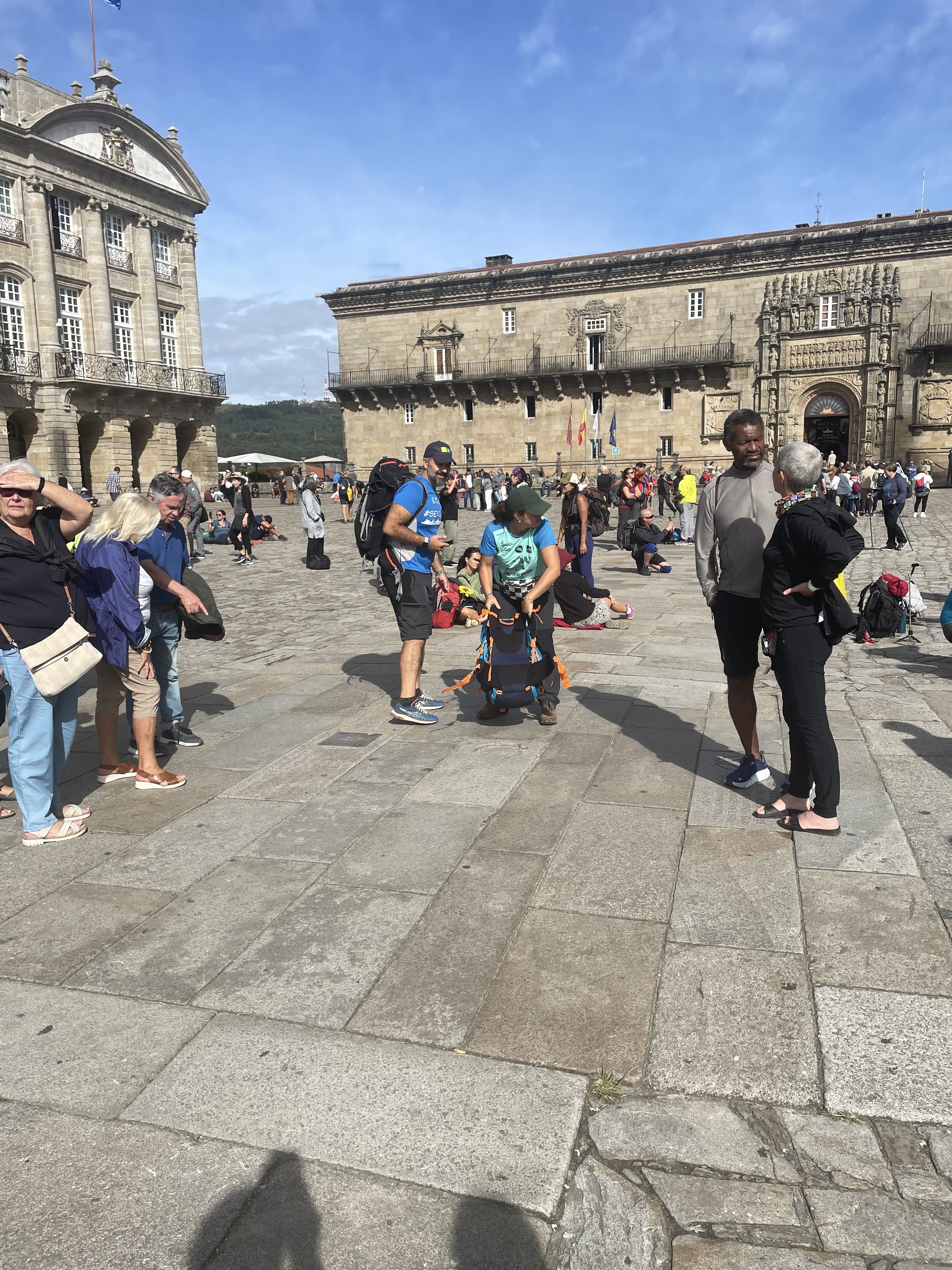
  There was a gigantic baroque cathedral with a huge plaza out front where the pilgrims officially finished their hike. It was fun to watch them arrive and pose for photos by the paving stone with the big scallop shell. They looked muy, muy feliz. There were dozens of little restaurants and even more souvenir shops in the narrow, winding streets around the cathedral. There were extra churches around the cathedral and museums to explain it all.

"We made it!"


  The Museum of the Camino explained what the big deal was about. St James was one of Jesus' favorite apostles. According to the Bible, he was beheaded in Jerusalem for preaching the gospel. According to tradition he had gone Spain at some point to spread the good news. After his beheading, his Spanish disciples brought his body to Spain for burial.  In the eighth century a monk had a vision of Saint James' grave. The local bishop built a much nicer tomb and the local king made a pilgrimage and built a church over the tomb and the pilgrims have been coming ever since.

The Saint is in.


  St. James' bones are in a crypt under the cathedral's main altar. Does the silver encrusted chest really contain the bones of the apostle? I'm certainly not going to spoil the fun at this late date. 


Donated pilgrims' walking sticks. 
The pilgrims encourage each other with Ultreia! Further!

Sunday, February 19, 2023

A Streetcar Named Museum


     I've been rereading or rather relistening to Ulysses by James Joyce. My Hard Books Book Club put the hard work required into understanding this notoriously difficult book a couple of years ago. It's a puzzle. Once solved I framed it and hung it on the wall.  Once a year I take it down and lose myself in its intricacies. 

  People in the book in the Dublin of 1904 are always jumping on trams to get around town. Sometimes characters complain there aren't enough tram lines, but a look at the old system map shows Dublin was pretty well covered. If you were in a hurry you could hire a horse drawn hack the way we use taxis or Uber 

  There were trains to other parts of the country and if you weren't in a hurry there were canal barges. This tram system reminded me of the system of subways, busses and streetcars of my youth in Boston. You could ride the whole system all day for a nickel if you remembered to get a paper transfer when changing lines. 

  By brother Bill explored the city on his bike. Not me. I have no sense of direction or memory for the way I have come. No, once I had my map of the system I could ride to the far ends of the system. To get to my high school I took a bus then an elevated train or a streetcar. I used to alternate between streetcar and train to keep things fresh. 

  One cold bright early spring morning our class was scheduled for a field trip to the Museum of Science just off downtown. I had ridden to the museum by myself before and knew the streetcar that went to the museum was on a different line from the one that I rode to school. I assumed we would have to ride downtown then switch lines.

  Brother More led us to the stop where I had gotten off the trolley that morning. The tracks here ran down the center of Huntington Avenue. The streetcars always ran in tandem, but soon a single car arrived and picked us all up. The school had chartered a streetcar to keep us all in hand. There was always a joker looking for a chance to get "lost". 

The streetcar went underground as we approached downtown. In the dimly lit tunnel it did some fancy switching and soon emerged in the light on the Lechmere Viaduct and crossed the river to the museum. Why do minor incidents like this remain so bright in the memory when I can't remember whether I turned left or right in Cleveland? If I ever write an incomprehensible novel, this streetcar will provide one of its many keys. It will, yes.


"Brang Brang!


Friday, August 26, 2022

The Anarchist

   Immediately after President Kennedy was assassinated in 1963, a great number of books appeared on the shelves turning the dead president into a martyr and turning a quick buck for the authors. I recently came across a beat up old book in a second hand bookstore that had been cranked out immediately after the assassination of President McKinley in 1901.

  The book was definitely a rush job, padded with photographs and purple prose. McKinley was shot twice in the chest on September 6, 1901. He was expected to recover, but died from gangrene on September 14. When the book was published the assassin was still living. The author suggested he be kept alive as an example. No one listened to him and the assassin was electrocuted on October 29 of that same year.

  Anarchism was the Terrorism of McKinley’s day. Teddy Roosevelt, a few years before becoming president upon McKinley's death, said anarchism was the main problem in the country. Anarchism is a philosophy that rejects the authority of the state. Pure communism or libertarianism are synonymous with it. Anarchists will use evolutionary change when they can. Otherwise violent revolution will be their tactic.

  McKinley's assassin was Leon Czolgosz (CHOL-gosh), the son of Polish immigrants. Czolgosz was born in Michigan and came of age during the Depression of 1893. He lost his job as a steelworker and joined a socialist club, taking an interest in anarchism. He became a fan of the popular anarchist Emma Goldman. When he tried to befriend Goldman, she and her group were put off by his odd behavior and thought he was an infiltrator. 

  Czolgosz was rebuffed by other anarchist groups and decided to work alone after being inspired by the assassination of the Italian king by a lone gunman in 1900. Czolgosz bought a revolver and headed to Buffalo in early September, 1901, where McKinley would be speaking at the Pan-American Exposition. Czolgosz attended McKinley's speech on September 5, but was not able to get close enough to the president.

   The next day Czolgosz joined the line that was shaking hands with McKinley. Czolgosz carried his pistol wrapped in a handkerchief as though his hand was injured. This might have alerted the security detail, but the man ahead of Czolgosz in line was a dark-skinned Italian who got most of the guards' attention. As McKinley took his hand, Czolgosz fired two bullets into McKinley's chest. The crowd set upon Czolgosz and probably would have killed him if McKinley had not ordered his guards to protect him.

  McKinley lingered another eight days. The surgeon was unable to find the second bullet. There were no antibiotics then to fight the infection growing in the president's abdomen. McKinley had been a popular president. Prosperity had returned to the country during his first term and there was an outpouring of grief at his death on September 14.

   Czolgoz pleaded guilty and refused to cooperate with his lawyer. His trial was swift and despite obvious signs of insanity, he was condemned to death and electrocuted on October 19. The old book about the assassination has no personal information about Czolgosz. That would only come out in the following months.  The author of the book has to content himself with describing Czolgosz as a "damnable assassin," a "murderer by profession," and "a hissing serpent in the weeds." Correction, that last was the author's description of the assassin of President Garfield in 1881. John Wilkes Booth was simply a "madman." All three assassins were "bloody miscreants."

  The last eight pages of the book are ruled blank pages which I thought were for notes, but were actually a form for ordering additional copies, "bound in extra SILK CLOTH, inlaid Photographs. RETAIL PRICE ONLY .  . $1.50. I only had to pay a dollar for my copy.


From "Illustrious Life of William McKinley"

Sunday Squibs (August 21, 2022)

 You’ll have much better luck getting a spare part from the shop that works on the thing rather than from the place where you bought it. 


The old saints wore prickly hair shirts for penance. We modern saints have as hair shirts our civilization’s bright lights and noises. 


Once I was scornful of pro wrestling. Now I admire it as a rough ballet followed by truly mad balletomanes. 


A mystery movie focuses on who done it. 

A horror flick focuses on who it is done unto. 


The future of the procrastinator is constantly ducking to let his present stride over it. 


When mastering any science, we don’t go down a rabbit hole, rather we dig the rabbit out of his hole. 


A faith to move mountains? Miracle enough to change hearts of stone into flesh and blood. 


Saying no one loves me is ridiculous. If you say no one loves me like I want to be loved, I will believe you and make a discreet exit. 

A Birthday Bash for Ogden Nash (August 19, 2022)


The City of Nashville was named for Uncle Frank

In the war with Great Britain he held a general’s rank

Young Ogden said no to all that doo-dah

So they named after him that town in Utah


   I love Ogden Nash for his name alone. And yes, Nashville was named for his great, great uncle Francis. I also admire him because he made a good living by his very short poems. That was his secret: he encapsulated great truths in a few lines.


A Word to Husbands


To keep your marriage brimming 

With love in the loving cup,

Whenever your wrong admit it:

Whenever you’re right, shut up.


   There's a truth admitted by all to be right. And no one but Ogden Nash could have put it so prettily. It took Nash many years to settle on poetry as an occupation. He claims he started rhyming at the age of six and admitted that finding the right rhyme can be hard. It became easier when he started making up his own words which is the right of any real poet.


Further Reflections on Parsley


Parsley
Is gharsley.


  He tried Harvard but that was too serious a place for him. So he went to New York and tried to sell bonds, but never got the hang of it. In two years he only sold one bond and that one to his godmother. 


Introspective Reflection


I would live all my life in nonchalance and insouciance
Were it not for making a living, which is rather a nouciance.


  He got a job writing the ads on streetcars and started sending his poems to The New Yorker which recognized his genius. In 1931 he got married and published his first book which became a best seller. He never looked back. He led a charmed life appearing on TV, giving lectures, writing screenplays, and of course writing hundreds and hundreds of more poems. 


  When he died at age 68 in 1971 his obituary said his "droll verse with its unconventional rhymes made him the best-known producer of humorous verse in the country." He could slip a serious one in occasionally.


Old Men


People expect old men to die,

They do not really mourn old men.

Old men are different. People look

At them with eyes that wonder when...

People watch with unshocked eyes;

But old men know when an old man dies.


The City of Nashville was named for Uncle Frank

In the war with Great Britain he held a general’s rank

Young Ogden said no to all that doo-dah

So they named after him that town in Utah


   I love Ogden Nash for his name alone. And yes, Nashville was named for his great, great uncle Francis. I also admire him because he made a good living by his very short poems. That was his secret: he encapsulated great truths in a few lines.


A Word to Husbands


To keep your marriage brimming 

With love in the loving cup,

Whenever your wrong admit it:

Whenever you’re right, shut up.


   There's a truth admitted by all to be right. And no one but Ogden Nash could have put it so prettily. It took Nash many years to settle on poetry as an occupation. He claims he started rhyming at the age of six and admitted that finding the right rhyme can be hard. It became easier when he started making up his own words which is the right of any real poet.


Further Reflections on Parsley


Parsley
Is gharsley.


  He tried Harvard but that was too serious a place for him. So he went to New York and tried to sell bonds, but never got the hang of it. In two years he only sold one bond and that one to his godmother. 


Introspective Reflection


I would live all my life in nonchalance and insouciance
Were it not for making a living, which is rather a nouciance.


  He got a job writing the ads on streetcars and started sending his poems to The New Yorker which recognized his genius. In 1931 he got married and published his first book which became a best seller. He never looked back. He led a charmed life appearing on TV, giving lectures, writing screenplays, and of course writing hundreds and hundreds of more poems. 


  When he died at age 68 in 1971 his obituary said his "droll verse with its unconventional rhymes made him the best-known producer of humorous verse in the country." He could slip a serious one in occasionally.


Old Men


People expect old men to die,

They do not really mourn old men.

Old men are different. People look

At them with eyes that wonder when...

People watch with unshocked eyes;

But old men know when an old man dies.